

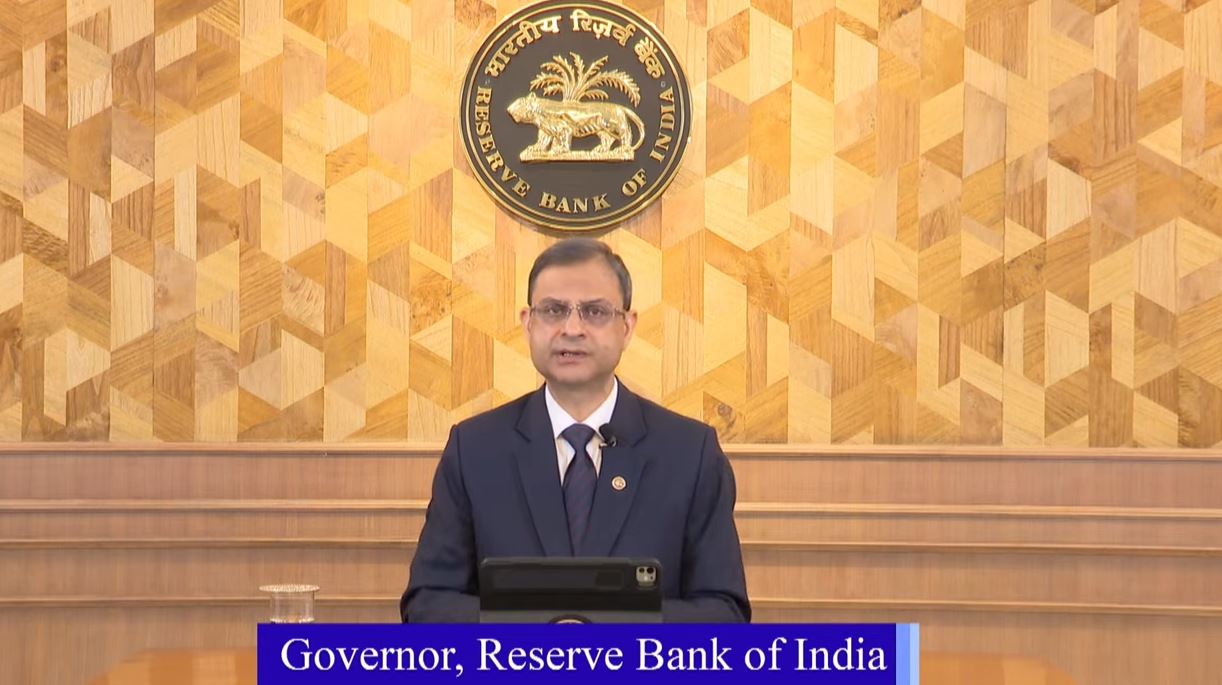
Mumbai, October 7: The Reserve Bank of India (RBI) on Wednesday raised the policy repo rate by 25 basis points to 5.50 per cent, citing rising inflationary pressures and global economic uncertainties. The Monetary Policy Committee (MPC), which met from October 5 to 7, unanimously approved the rate hike and changed its policy stance from neutral to “calibrated tightening.”
Following the decision, the Standing Deposit Facility (SDF) rate has been raised to 5.25 per cent, while the Marginal Standing Facility (MSF) rate and Bank Rate stand at 5.75 per cent.
RBI Governor Sanjay Malhotra chaired the 63rd meeting of the MPC. While the rate hike was unanimous, two members—Dr Nagesh Kumar and Prof Ram Singh—favoured retaining the neutral stance.
The RBI said the Indian economy has remained resilient despite significant global headwinds. Real GDP growth in the first quarter of 2026-27 stood at 7.8 per cent, exceeding expectations, supported by strong private consumption, fixed investment, merchandise exports and services activity.
The central bank retained its 2026-27 GDP growth forecast at 7.1 per cent. Growth is projected at 7.2 per cent in the second quarter, 6.9 per cent in the third quarter and 6.8 per cent in the fourth quarter. Growth for the first quarter of 2027-28 is projected at 7.1 per cent.
However, inflation has emerged as a major concern. Consumer Price Index (CPI) inflation increased to 4.8 per cent in August from 4.5 per cent in July, with food and fuel prices contributing significantly. Core inflation also rose to 4.2 per cent.
The RBI has raised its CPI inflation forecast for 2026-27 to 5.2 per cent, with inflation projected at 4.9 per cent in Q2, 6 per cent in Q3 and 5.7 per cent in Q4. Core inflation is projected at 4.4 per cent for the year.
The central bank flagged risks from a deficient southwest monsoon, strong El Niño conditions, elevated energy and commodity prices and continuing geopolitical tensions arising from the West Asia conflict. Higher crude oil price volatility and tighter global financial conditions could also affect the domestic economy.
The RBI said India’s growth momentum remains broad-based, with strong services activity, robust credit flows, capacity utilisation and government infrastructure spending expected to support investment.
The shift to calibrated tightening effectively signals that rate cuts are off the table in the near term. Future policy action will depend on evolving inflation and growth conditions, including the extent to which supply-side shocks become embedded in underlying inflation.
The minutes of the MPC meeting will be released on October 21. The next MPC meeting is scheduled for December 2-4, 2026.