
Global Crude Steel Output Falls 3.7% in December 2025 as China Drag Offsets Gains in India, Middle East

World crude steel production declined in December 2025, weighed down by a sharp contraction in China, even as India, Türkiye and the Middle East recorded strong growth, according to data released by the World Steel Association (worldsteel).
World crude steel production across the 70 countries reporting to worldsteel stood at 139.6 million tonnes (Mt) in December 2025, marking a 3.7% year-on-year decline compared with December 2024. The global downturn was largely driven by Asia, particularly China. Asia and Oceania produced 99.7 Mt, down 6.3%, reflecting weaker demand, capacity adjustments and policy-led production controls in major economies. China, the world’s largest steel producer, recorded the steepest fall among top producers, with output dropping 10.3% year-on-year to 68.2 Mt. The decline significantly impacted overall global figures. In contrast, India emerged as a bright spot, producing 14.8 Mt, an increase of 10.1%, supported by strong infrastructure spending, construction activity and continued industrial demand. India consolidated its position as the world’s second-largest steel producer.
Regional performance showed a mixed picture:
- Africa produced 1.9 Mt, marginally down 0.3%.
- The EU (27) saw output rise 3.9% to 9.9 Mt, indicating tentative recovery.
- Europe (Other) posted a sharp 13.8% increase to 3.8 Mt.
- The Middle East recorded strong growth, with production up 13.9% to 5.3 Mt, led by capacity expansion and domestic demand.
- North America produced 9.0 Mt, down slightly by 0.4%.
- Russia & other CIS plus Ukraine produced 6.9 Mt, down 2.7%.
- South America saw output edge up 1.2% to 3.2 Mt.
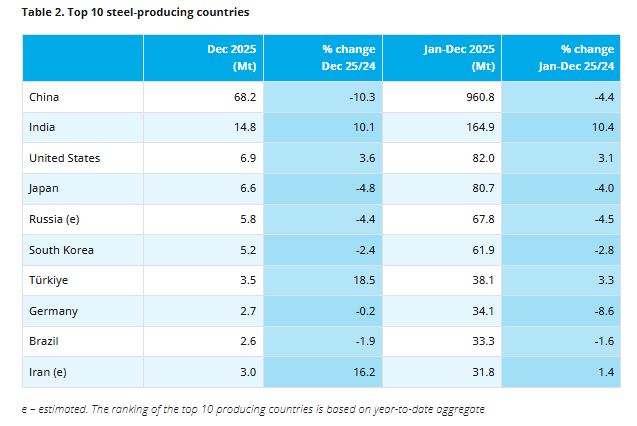
Industry analysts note that while global steel demand remains under pressure from slowdowns in key markets, India, the Middle East and Türkiye are increasingly driving incremental growth, partially cushioning the impact of China’s slowdown.
The December figures underline a shifting global steel landscape, with emerging economies gaining relative importance amid structural changes in traditional steel-producing regions.